
Home / Advice Centre / Running Costs / How Much Does a Heat Pump Cost to Run?
ADVICE CENTRE · RUNNING COSTS
How much does a heat pump cost to run? The real arithmetic, shown in full
Running-cost claims are where heat pump marketing gets most creative. This guide gives you the actual formula, honest worked examples, and the design factors that decide whether your bills land on the happy side of the projection.
- 12 min read
- Updated July 2026
- By Phil · Heat Loss Hub
QUICK ANSWER
For a typical UK home needing 10,000–14,000 kWh of heat a year, a well-designed heat pump achieving a seasonal efficiency (SCOP) of 3.5–4.5 costs roughly £700–£1,100 a year to run for heating and hot water at standard 2026 electricity prices — less on a heat-pump tariff. The same heat from oil or LPG typically costs similar or more, and the gap widens every point of efficiency the design earns. The honest caveat: those SCOP numbers are design outcomes, not product features. A badly designed system can cost half as much again to run — same heat pump, same house.
The only formula you need
Every running-cost claim, honest or otherwise, reduces to one line of arithmetic:
Annual cost = (Annual heat demand in kWh ÷ SCOP) × electricity price per kWh
Three inputs. That’s all. And each one is knowable rather than guessable:
- Annual heat demand — how much heat your house actually needs across a year, for space heating and hot water. This comes from your measured heat loss and location, or from your real gas/oil consumption history (a wonderfully honest source, because you’ve already paid for it).
- SCOP — seasonal coefficient of performance: the average number of units of heat delivered per unit of electricity across a whole heating season. The single most important number in this article.
- Electricity price — your tariff. Standard rates, or increasingly a dedicated heat pump tariff with cheaper smart-metered rates.
When a projection looks too good, one of the three inputs has been flattered. Now you know where to look.
SCOP: the number that does the work
A heat pump doesn’t convert electricity into heat — it uses electricity to move heat from outdoor air into your home. That’s how one kWh in becomes three, four or five kWh of warmth. How many depends chiefly on the temperature lift: the smaller the gap between outside air and your flow temperature, the better the ratio.
You’ll see two efficiency numbers in the wild. COP is a snapshot at one test condition — the “up to 5.39” in a brochure is a COP at favourable temperatures. SCOP is the season-long average at your design flow temperature — the number your bills are made of. A unit with a dazzling COP can still deliver a mediocre SCOP if the system around it forces high flow temperatures.
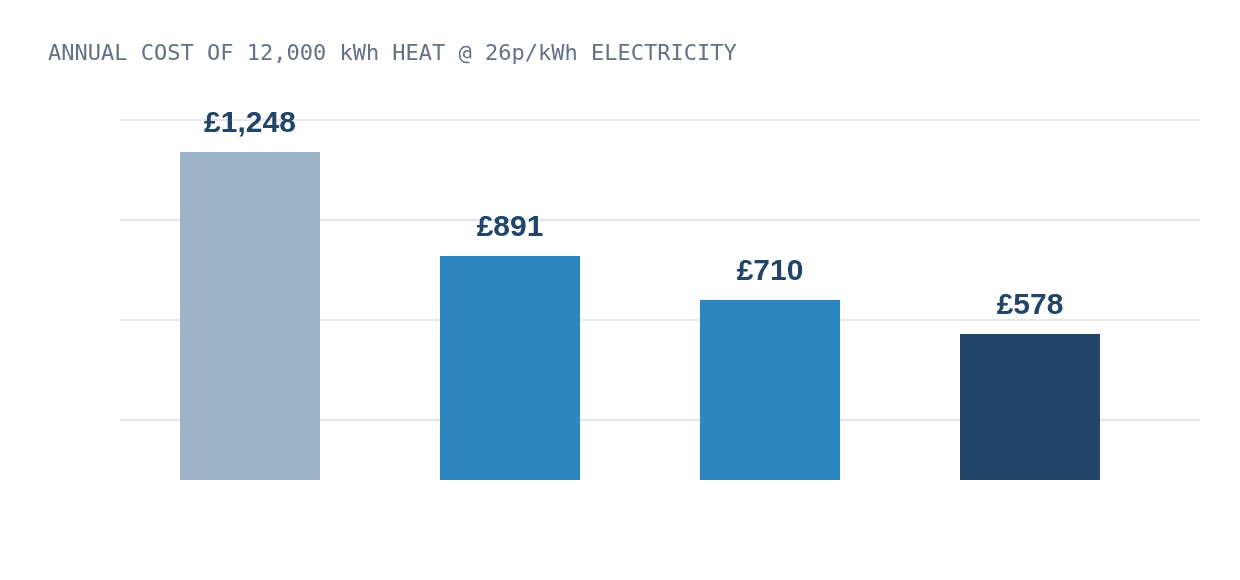
FIG. 01 — Same house, same heat, same tariff. Design quality is worth hundreds of pounds a year, every year. Illustrative prices, July 2026.
Three honest worked examples
WORKED ANNUAL RUNNING COSTS — HEATING + HOT WATER, STANDARD TARIFF AT 26P/KWH (ILLUSTRATIVE, 2026)
| Home | Annual heat demand | Designed SCOP | Electricity used | Annual cost |
|---|---|---|---|---|
| Modern 3-bed semi, 45 °C flow | 9,500 kWh | 4.2 | 2,262 kWh | ≈ £588 |
| 1930s 4-bed semi, 47 °C flow | 13,500 kWh | 3.9 | 3,462 kWh | ≈ £900 |
| Stone farmhouse, 52 °C flow | 21,000 kWh | 3.4 | 6,176 kWh | ≈ £1,606 |
Tariffs change the game
The examples above use a standard variable rate. Heat pump owners increasingly do better:
- Dedicated heat pump tariffs offer reduced smart-metered rates — several suppliers now price heat pump electricity 15–30% below standard rates, either all day or in generous windows.
- Time-of-use tariffs reward the heat pump habit of steady running plus a well-insulated cylinder: heat water in the cheap window, coast through the peak.
- Solar PV pairs naturally — shoulder-season heating and summer hot water soak up generation that would otherwise export for pennies.
Design connects here too: a system with weather compensation and a decent cylinder can shift load into cheap hours without you noticing; an undersized cylinder and a shouty third-party thermostat can’t. Tariff strategy is part of our controls specification, not an afterthought.
Why design decides your bill
Two identical heat pumps, two identical houses, running costs 40% apart. We see it in design reviews constantly. The differences are always the same short list:
- Flow temperature — the big one. Every 10 °C lower is roughly 20–25% off the heating bill. This is set by emitter sizing decisions made at design time: see the radiator guide.
- Right-sizing — an oversized unit cycles on and off in mild weather, hammering efficiency exactly when the season offers its best conditions. See What size heat pump do I need?
- Weather compensation actually commissioned — flow temperature that tracks the weather instead of sitting at design maximum all winter. Costs nothing; worth a great deal; frequently left on factory settings.
- Hydraulic honesty — buffer tanks and low-loss headers added “for safety” that blend flow temperatures upward; correct pipe sizing that lets the unit modulate properly.
- System balancing — the unglamorous afternoon with the lockshields that decides whether the far bedroom forces the whole house to run hot.
DESIGNER'S INSIGHT
“When someone tells me their neighbour’s heat pump is expensive to run, I can usually name the fault from the symptoms over the phone: radiators kept at boiler sizes, flow temperature parked at 55 °C, compensation never enabled. The heat pump gets the blame; the missing design did the damage. It’s why our commissioning spec states the curve settings — the installer shouldn’t have to guess what the design intended.”
Phil
Founder & Lead Designer, Heat Loss Hub
Don't forget hot water
Hot water is typically 15–25% of the annual load and runs at a fixed target (usually 48–52 °C in the cylinder) whatever the weather, so its efficiency is lower than space heating’s — a COP around 2.5–3 is realistic. Good design keeps it cheap anyway: a properly sized cylinder heated once or twice daily in off-peak windows, a weekly legionella cycle rather than a nightly one, and reheat scheduled around your household rather than a factory default. Poor design — an undersized cylinder reheating at peak rate five times a day — quietly adds £100+ a year that gets blamed on “the heat pump”.
Frequently asked questions
At mid-2026 prices, electricity costs roughly four times gas per kWh, so you need a seasonal efficiency around 4 to match gas bills — achievable with good design in suitable homes, and heat pump tariffs tilt the sums further. Against oil, LPG or direct electric heating the comparison is far more comfortable. Where gas parity matters to you, the design’s flow temperature becomes everything.
Divide your annual heat demand by the SCOP: a 13,500 kWh home at SCOP 3.9 adds ~3,460 kWh a year — roughly doubling a typical home’s electricity consumption but deleting the fuel bill it replaces. Peak draw for most domestic units is 2–4 kW; supply adequacy is checked at survey.
Efficiency dips as temperatures drop — that’s physics — but design-day conditions occupy a handful of days a year, and a right-sized system still delivers COP 2–2.5 at −5 °C. The season average (SCOP) already includes the cold snaps. Beware anyone quoting only mild-weather COPs; that’s the brochure number, not the bill number.
No honest engineer guarantees a bill — weather, tariffs and how warm you like your lounge all belong to the year, not the design. What we provide is a projection with every assumption stated (heat demand, SCOP at your flow temperature, tariff), so you can flex each input yourself and see honestly where the risks sit.
CONTENTS
YOUR NUMBERS?
Every Heat Loss Hub design includes a running-cost projection built from your measured heat loss — not a brochure’s optimism.
PROJECTIONS YOU CAN TRUST
Want the running-cost sums for your house?
Every design includes a running-cost projection built from your measured heat loss, your flow temperature and your tariff — assumptions stated, arithmetic shown.