
Home / Advice Centre / Sizing / What Size Heat Pump Do I Need?
ADVICE CENTRE · SIZING
What size heat pump do I need? Measured, not guessed — and why bigger isn't safer
Heat pump sizing is where more money is silently wasted than anywhere else in this industry — in both directions. This guide explains how sizing actually works, why “kW per bedroom” rules fail, and what oversizing really costs you.
- 12 min read
- Updated July 2026
- By Phil · Heat Loss Hub
QUICK ANSWER
The right heat pump size equals your home’s measured heat loss at your local design outside temperature — verified against the manufacturer’s output data at that temperature and your design flow temperature. For UK homes that’s typically 4–6 kW for modern semis, 6–9 kW for pre-war family homes and 10–16 kW for large or stone-built properties. No floor-area formula, bedroom count or boiler-size comparison can produce this number — and oversizing “to be safe” makes your system less efficient, less comfortable and more expensive twice over.
How sizing actually works
Three steps, none optional:
- Measure the heat loss. A room-by-room calculation from surveyed dimensions, verified constructions and honest air-change rates gives your whole-house load in kW at the design condition — the near-worst-case cold day for your location (around −2 °C to −5 °C across most of England and Wales).
- Fix the flow temperature. Sizing and emitters are one decision: the flow temperature your radiators need (see the radiator guide) changes the unit’s usable output. A “7 kW” heat pump is not 7 kW at every temperature.
- Verify against manufacturer output tables. Find the actual output of the candidate unit at your design outside temperature and your flow temperature, ensuring it covers the load — with defrost behaviour accounted for and without leaning on the backup heater. The model’s marketing name is irrelevant; the table row is everything.
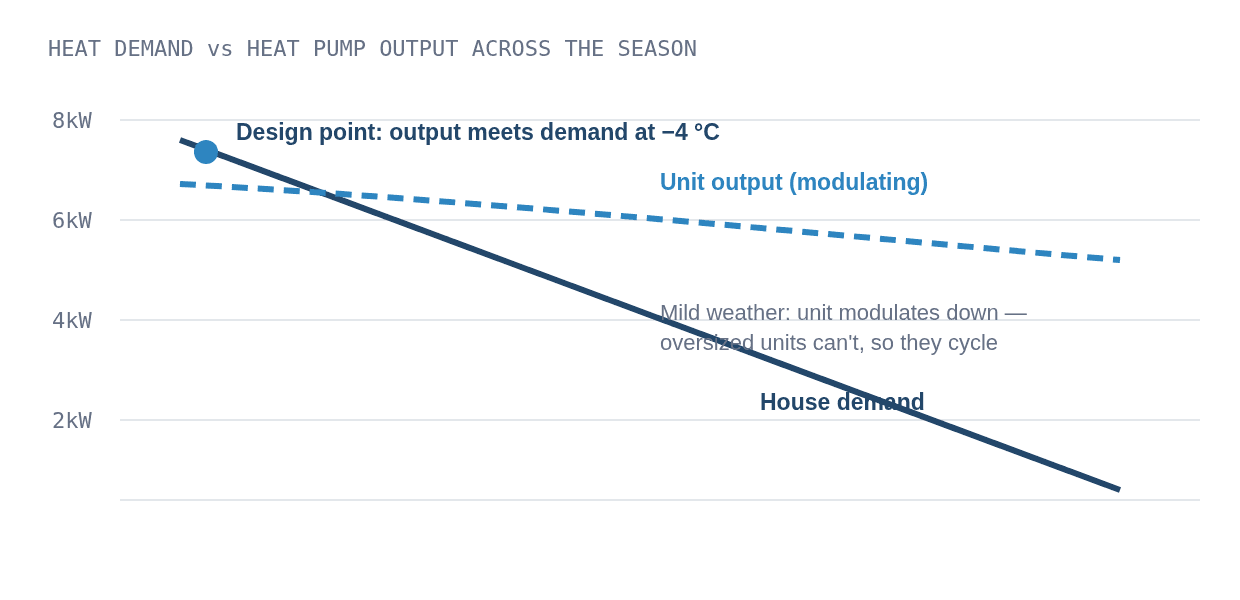
FIG. 01 — Right-sizing means the unit meets the design day exactly and modulates gracefully through the other 360 days.
Why rules of thumb fail
“1 kW per 10 m²” — treats a 2024 flat and an 1890 terrace of equal area as the same building; they differ by a factor of three or more in W/m².
“Match the boiler size” — your 28 kW combi was sized for instant hot water, not heating. Most homes with 24–30 kW boilers have measured heat losses of 5–9 kW. Copying the boiler number quadruple-oversizes the heat pump and is the single most destructive shortcut in circulation.
“kW per bedroom” — bedrooms are the lowest-loss rooms in the house. Counting them predicts family size, not physics.
“Go one bigger, winters are getting weird” — the design temperature already represents a statistically severe cold event, and units carry defined output down to −15 °C and beyond. Weather anxiety is priced in; adding a size on top just buys the oversizing problems below.
The true cost of oversizing
Oversizing feels safe and costs you three ways:
- Cycling. Most of the heating season is mild — your house might need 2 kW on a 10 °C day. A right-sized unit modulates down and purrs along; a 12 kW unit whose minimum output is 4 kW cannot, so it starts, overshoots, stops, and repeats — dozens of times a day. Every cycle is an efficiency loss and a unit of wear on the compressor.
- Efficiency. Heat pumps post their best numbers running steadily at part load. Chronic cycling can shave 10–20% off achievable SCOP — hundreds of pounds over years, invisible on any invoice.
- Capital. Bigger units, bigger pipework and often an added buffer tank to mask the cycling the oversizing caused — you pay extra to create the problem and to hide it.
When we review quotes, oversizing is the most common fault we find — see why quotes differ for the incentives behind it.
The true cost of undersizing
Rarer, but real: a unit below the honest design load leans on its electric backup heater through every cold snap — at COP 1, triple the running cost of pumped heat — and the house creeps cold on exactly the mornings you care most. Marginal undersizing with fabric improvements planned can be a legitimate, documented choice; accidental undersizing from an optimistic survey is just the mirror image of the same missing measurement. The design margin belongs in the calculation’s honesty, not slapped on the unit size afterwards.
DESIGNER'S INSIGHT
“The question I’m really answering isn’t ‘how big?’ — it’s ‘what does this house need on its worst afternoon, and how gracefully can the unit behave on the other 360 days?’ A 6 kW that modulates to 1.8 beats an 8 kW that bottoms at 3.2, in the same house, every time. That nuance lives in the manufacturer’s tables, and nowhere else.”
Phil
Founder & Lead Designer, Heat Loss Hub
Reading manufacturer data properly
Two traps to know about, even if you delegate the rest:
- Names aren’t outputs. A “7 kW-class” unit may deliver 7.5 kW at 7 °C outside but only 5.8 kW at −4 °C and 50 °C flow. The output that matters is at your design point; some brands’ naming flatters, others sandbag. This is why our designs quote the table row, not the model name.
- Minimum modulation matters as much as maximum output. The unit’s floor determines how it behaves for the 80% of the season that is mild. A wide modulation range is worth more to your bills than an extra kW of headline capacity.
These checks also happen to be excellent questions to put to any installer whose quote names a unit: “What’s its output at our design temperature and flow temperature, and what’s its minimum modulation?” Engineers answer instantly. Brochure-readers pause.
Hot water and other sizing myths
“Add 2 kW for hot water.” No — hot water is a scheduling load, not a simultaneous one. The cylinder reheats in gaps in the heating day (or in a cheap tariff window); the correct response to a big household is a bigger cylinder or coil, not a bigger heat pump.
“Add a bit for the extension you might build.” Design for the house you have; document the assumption; revisit if the extension happens (it often changes emitters more than the unit anyway). Buying five years of cycling for a hypothetical orangery is poor value.
“The buffer tank fixes sizing.” A buffer can mask cycling — at the price of blended temperatures and lost efficiency. Treat “we always fit a buffer” as a small amber flag worth one polite question: “what problem is it solving in this design?”
Frequently asked questions
Commonly 4–7 kW — but the range across superficially similar semis is huge (a 2005 semi at 4 kW; an extended, unimproved 1930s one at 9 kW). The measurement costs a fraction of the error; that’s the honest answer behind every “typical” figure.
Whoever can show a room-by-room calculation with stated assumptions, a design temperature, and a manufacturer table row at your conditions. If nobody can, believe none of them yet — an independent review or fresh measured calculation settles it for less than the cost of getting it wrong.
Room setpoints are design inputs and we’ll happily set your lounge at 22 °C if that’s how you live — transparently, in the calculation. That’s different from silently inflating the whole design: one is personalisation, the other is oversizing with better manners.
Output falls as flow temperature rises, so the same building needs more capacity headroom at 65 °C than at 45 °C — one more reason the cheap-looking “no radiator changes, high-temp unit” route often costs more in metal and in bills. The design compares both routes honestly.
CONTENTS
SIZE IT PROPERLY
A Heat Loss Hub design sizes your heat pump from a measured room-by-room heat loss and real manufacturer data — the only method that deserves the word.
SIZING IS MEASURING
One number decides your system. Get it measured.
Room-by-room heat loss, design-point verification against manufacturer data, and a size you can defend to anyone. Start with the enquiry form.